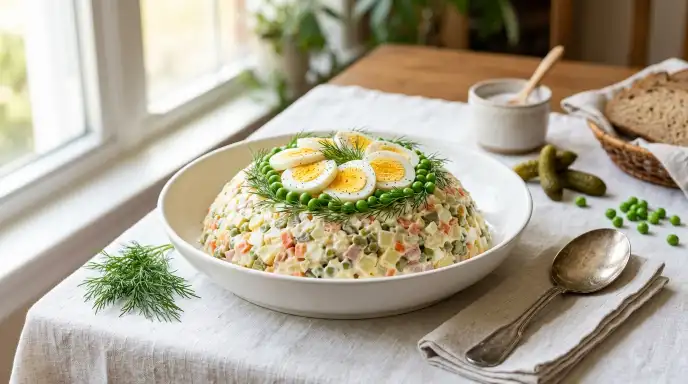
This russian salad recipe has been a staple at family gatherings for as long as I can remember — and for very good reason.
It’s creamy, hearty, and packed with simple ingredients that somehow create something truly spectacular together.
Perfect for holidays, potlucks, or anyone who loves a classic comfort dish with a little old-world charm.
The Best Russian Salad Recipe – Creamy, Classic & Crowd-Pleasing Every Single Time
Recipe Overview
| Detail | Value |
| COURSE | Salad / Side Dish / Appetizer |
| CUISINE | Russian / Eastern European |
| DIFFICULTY | Easy |
| SERVINGS | 6–8 servings |
| PREPARATION TIME | 20 minutes |
| COOKING TIME | 25 minutes |
| CALORIES | ~280 per serving |
Equipment Needed
- Large pot (for boiling vegetables and eggs)
- Cutting board
- Sharp chef’s knife
- Large mixing bowl
- Slotted spoon or colander
- Measuring spoons and cups
- Small mixing bowl (for dressing)
- Plastic wrap or airtight container (for chilling)
Ingredients
For the Salad:
- 3 medium Yukon Gold potatoes (about 1½ lbs), boiled and cooled
- 3 medium carrots, boiled and cooled
- 3 large eggs, hard-boiled and cooled
- 1 cup frozen peas, thawed (no cooking needed)
- 3 medium dill pickles, finely diced (about ¾ cup)
- ½ cup cooked ham or bologna, diced into small cubes
- ¼ cup finely diced white or yellow onion
- 2 tablespoons fresh dill, finely chopped (plus extra for garnish)
For the Creamy Dressing:
- ¾ cup good-quality mayonnaise
- 1 tablespoon Dijon mustard
- 1 tablespoon pickle brine (from the pickle jar — don’t waste that liquid gold!)
- 1 teaspoon white wine vinegar
- Salt and white pepper to taste
- ½ teaspoon sugar (optional, balances the flavors beautifully)
Substitutes & Variations:
- Swap ham for cooked chicken breast or canned tuna for a different protein
- Use sweet gherkins instead of dill pickles for a slightly sweeter flavor profile
- Replace mayonnaise with half mayo and half sour cream for a tangier, lighter dressing
- Add diced apple for a subtle sweetness that works surprisingly well
- Leave out the meat entirely for a satisfying vegetarian version
- Use red potatoes instead of Yukon Gold — both work beautifully here
Step-by-Step Instructions
Step 1: Start by placing your whole, unpeeled potatoes and carrots into a large pot of cold salted water.
Step 2: Bring the water to a boil over medium-high heat, then reduce to a steady simmer and cook for about 20–25 minutes until a fork slides in easily.
Step 3: While the vegetables cook, place your eggs in a separate small pot, cover with cold water, and bring to a boil.
Step 4: Once boiling, cook the eggs for exactly 10 minutes for perfectly hard-boiled yolks, then transfer immediately to an ice bath to stop the cooking.
Step 5: Drain the cooked potatoes and carrots and allow everything — vegetables and eggs — to cool completely before cutting (this is the number one rule of this russian salad recipe, and I cannot stress it enough).
Step 6: Once fully cooled, peel the potatoes, carrots, and eggs — the skins slip right off the vegetables after boiling, which feels oddly satisfying.
Step 7: Dice the potatoes, carrots, and eggs into small, uniform cubes — about ¼ to ½ inch — consistency here really does make the finished salad look beautiful.
Step 8: Finely dice the dill pickles, ham, and onion into similarly small pieces so no single ingredient overwhelms a bite.
Step 9: In a small bowl, whisk together mayonnaise, Dijon mustard, pickle brine, white wine vinegar, sugar, salt, and white pepper until completely smooth.
Step 10: Add all the diced vegetables, eggs, ham, pickles, peas, onion, and fresh dill into your large mixing bowl.
Step 11: Pour the creamy dressing over everything and fold gently — not stir aggressively — so the ingredients stay in distinct little cubes and don’t turn into mush.
Step 12: Cover the finished russian salad recipe tightly with plastic wrap and refrigerate for at least 2 hours before serving — overnight is honestly even better and worth the wait.
💡 Pro Tip: Always dice your ingredients while they’re fully cold — warm potatoes crumble and turn the whole salad gluey and sad.
💡 Bonus Tip: Reserve one hard-boiled egg and a few peas to slice and arrange decoratively on top before serving — it makes an already beautiful salad look absolutely stunning.
Ideas for Serving
This russian salad recipe is wonderfully versatile and feels right at home at everything from casual dinners to elegant holiday spreads.
- Serve it as a classic appetizer mounded on a platter, garnished with fresh dill, sliced eggs, and a few peas artfully arranged on top
- Spoon it alongside roasted chicken or beef tenderloin for a hearty, old-world Eastern European inspired dinner that feels deeply comforting
- Spread it on crusty rye bread or crackers as an easy, impressive party snack that guests will absolutely keep coming back for
- Pack it into lunchboxes for a filling, protein-rich midday meal that holds up beautifully for hours in the refrigerator
- Serve it at holiday gatherings like Christmas or Easter — it’s a beloved traditional dish that brings serious nostalgic warmth to any celebration table
Nutrition Information
| Nutrient | Amount (Per Serving) |
| Calories | ~280 kcal |
| Protein | 9g |
| Fat | 16g |
| Carbs | 24g |
About the Nutrition:
Potatoes are a genuinely excellent source of potassium, vitamin B6, and complex carbohydrates that provide steady, lasting energy.
Carrots contribute beta-carotene and vitamin A, supporting both eye health and immune function.
Eggs bring high-quality complete protein along with essential vitamins like B12 and D.
Green peas add plant-based protein, fiber, and a range of micronutrients including folate and iron.
While the mayonnaise dressing does add fat, using a lighter mayo or a half-sour-cream blend can reduce the calorie count without sacrificing that signature creamy richness.
Common Mistakes to Avoid
- Cutting vegetables while still warm — This is the biggest mistake beginners make; warm potatoes crumble and turn the entire salad into an unappetizing mash
- Dicing ingredients too large — Big uneven chunks mean unbalanced bites; take the extra time to cut everything into small, uniform pieces
- Skipping the chill time — This salad genuinely needs at least 2 hours in the refrigerator to let the flavors fully develop and meld; don’t serve it straight after mixing
- Over-dressing from the start — Add slightly less dressing than you think you need, toss gently, then add more as needed; you can always add more but you can’t take it away
- Using low-quality mayonnaise — The mayo is the backbone of this entire dressing, so use a good brand you actually enjoy eating on its own
- Skipping the pickle brine — That small tablespoon of brine adds a bright, tangy depth that lifts the whole dish; it’s a tiny ingredient with a massive impact
Conclusion
There’s something genuinely special about a dish that has stood the test of time across generations and entire continents.
This russian salad recipe is exactly that — humble ingredients, a little patience, and the kind of creamy, comforting result that makes people close their eyes when they take the first bite.
I’ve made this for Christmas dinners, Easter celebrations, and random Tuesday nights when I needed something cozy.
It always delivers, and it always gets asked for by name.
Make it once, refrigerate it overnight, and I promise you’ll understand exactly why this salad has been beloved for so long. 🥗
FAQs
1. How far in advance can I make this russian salad recipe?
You can make it up to 2 days ahead — it actually tastes better the next day as the flavors fully develop.
Store it covered tightly in the refrigerator and give it a gentle stir before serving.
2. Can I make a vegetarian version of this russian salad recipe?
Absolutely — simply leave out the ham or bologna entirely.
The combination of potatoes, carrots, eggs, and peas is hearty and satisfying enough completely on its own.
3. Why does my Russian salad turn out mushy?
The most common culprit is cutting vegetables before they’re fully cooled.
Always let boiled potatoes and carrots cool completely — at least an hour at room temperature — before dicing and combining.
4. Can I freeze Russian salad?
Freezing is not recommended at all — mayo-based salads separate and turn watery when thawed.
This salad keeps beautifully in the refrigerator for up to 3 days, which is plenty of time to enjoy every last bite.
5. What can I use instead of mayonnaise in the dressing?
Greek yogurt or a mix of sour cream and a little olive oil both work well as lighter alternatives.
The flavor profile will shift slightly but remain creamy, delicious, and totally satisfying.